In this blog post, you will learn what “ultraprocessed food” is, how our urban neighborhoods are structured to sell food that is unhealthy, and what we are doing to make Northside the healthiest neighborhood in Cincinnati.
Unless you’re eating raw fruits and vegetables, just about everything we eat is “processed” in some way, meaning, any treatment that alters the original form of the food. Even applying heat is a form of processing.
In 2019, a team lead by Dr. Rodrigo Rodrigues Petrus (Associate Professor of Food Engineering at the University of Sao Paulo in Brazil) created possibly the simplest classification explaining different degrees of food processing.
In brief, there are four classifications. Group 1 (Unprocessed and minimally processed food) is the least processed foods, and includes raw vegetables and fruits, and edible plants and seeds – these may be cooked, but have no added ingredients. Group 2 (Processed culinary ingredients) includes food from group one, with added basic ingredients like sugar, butter, and oils. Group 3 (Processed foods) are foods manufactured by industry, but use minimal ingredients to improve palatability and help stability. Foods such as pickles (cucumbers with added salt and garlic), cheese, or bread (flour with butter, yeast, salt, and sugar) are included in this category.
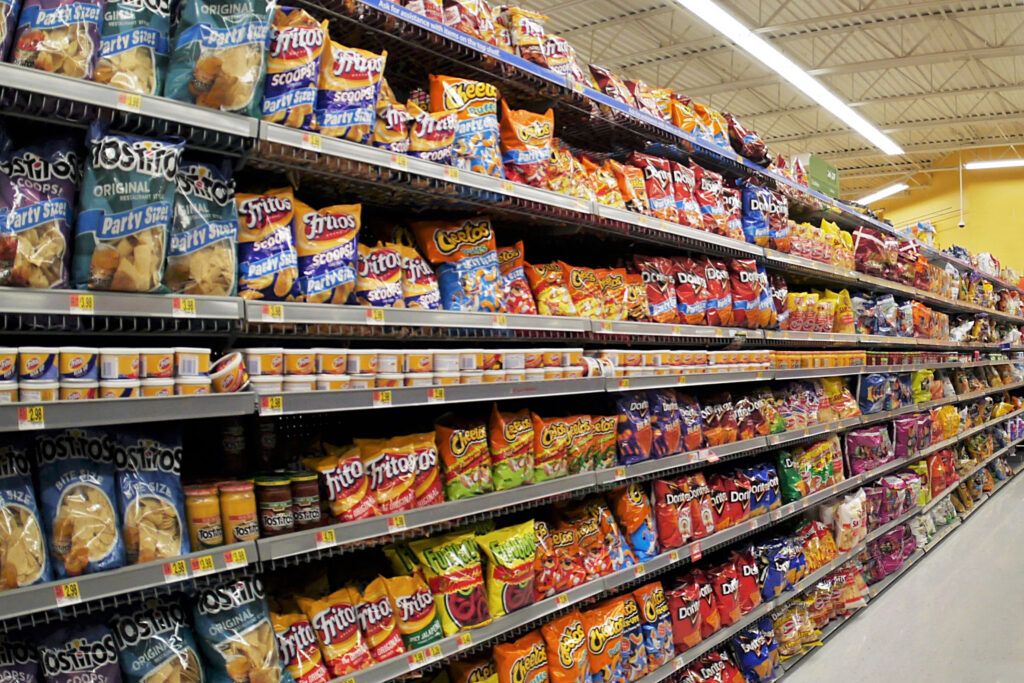
Group 4 – Ultraprocessed foods – are the ones we are most worried about. These foods are created by industry to have the greatest shelf stability and palatability. They include many ingredients that are created by industry and are not found naturally. These include foods like carbonated beverages, packaged snacks, packaged and prepared meals, instant soups, and even infant formula.
Many urban neighborhoods have stores that sell largely ultraprocessed foods (Group 4), mainly because they stay fresh on shelves for a long time, and are therefore cheaper to buy and sell. Healthier foods that don’t last as long on shelves in stores are harder to maintain (require refrigeration and can “go bad” more quickly), and are more expensive to sell. They require more frequent delivery, have a higher turnover and may not sell as much product as the more shelf stable packaged meals.
Studies have shown that diets rich in ultraprocessed foods are higher in calories, even when they are matched for nutrient content. Because of this, people tend to gain weight when they have diets consisting mainly of ultraprocessed foods.
This has a negative impact on our health in Northside. Recent data from the City of Cincinnati shows that our life expectancy varies by as much as 25 years depending on which neighborhood you live in. Of the 48 neighborhoods in Cincinnati, Northside ranks 17th in lifespan (73 years, as opposed to 88 years in Mt. Adams).
While the data doesn’t directly link access to healthy food as a cause, I hope to show that improving the nature of our food will improve our health in Northside.
This is why we at the Heart of Northside are working hard to increase access to healthy fresh produce that is grown right here in your neighborhood, and to provide you, our neighbors, with tools to learn how to make great meals with these foods. We are also working to provide fresh produce to local restaurants and stores so that healthy food will be available to everyone, thereby promoting better health.
We are now partnering with Melt Revival to learn what they need and what we can grow for them locally. This will help them continue to provide healthy meals at lower cost to you, and much greater benefit.
It is our dream at the Heart of Northside to create a system within our urban neighborhood that will provide healthy food and promote health. We look forward to seeing our community flourish!
photo: Thayne Tuason/Wikipedia